
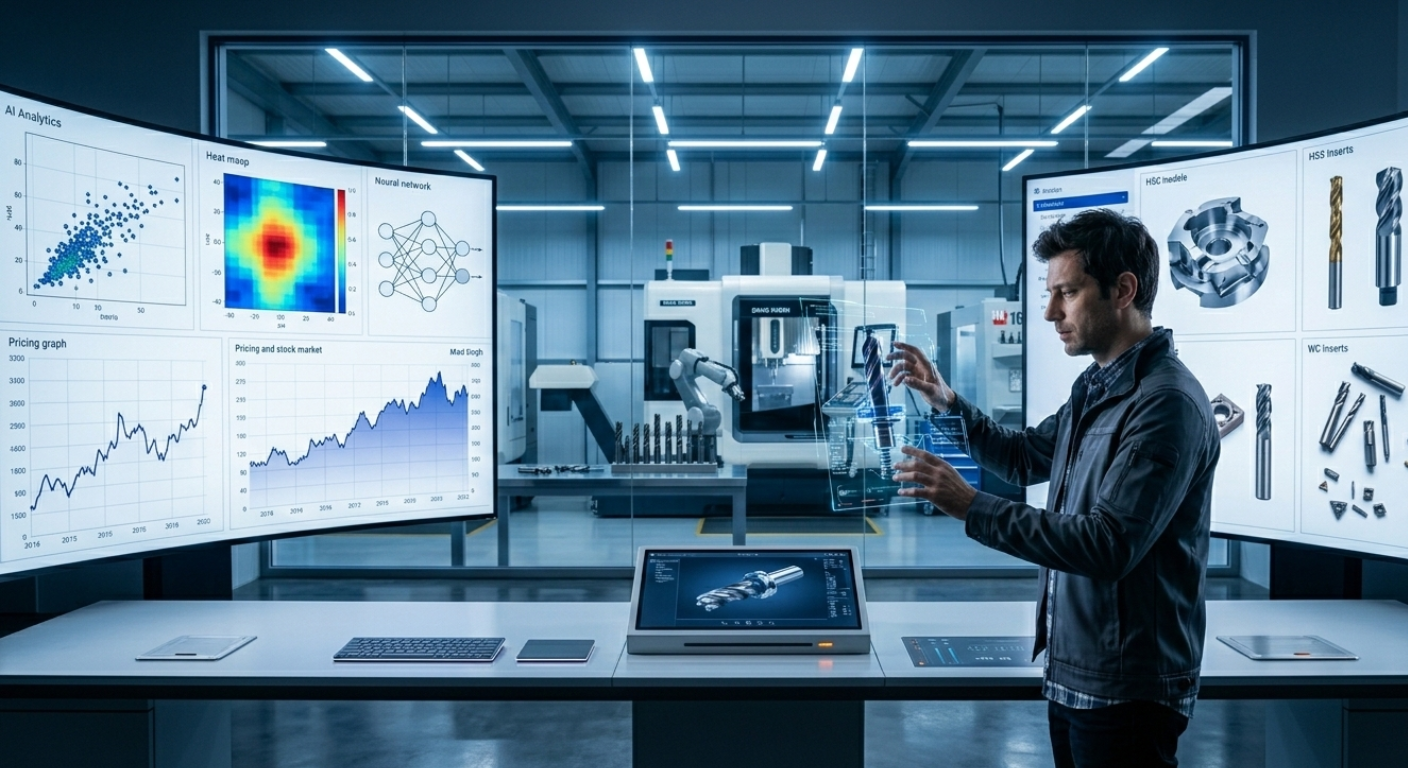
Featured Image Prompt: A sleek, futuristic manufacturing control room with large curved screens displaying AI analytics dashboards, real-time pricing graphs, and 3D product models. A manufacturing professional interacts with a holographic product configurator. Cool blue and white palette with subtle orange accent highlights. Clean, minimal, sci-fi meets industrial design.
Manufacturing has always been an industry that adopts technology to stay competitive. From manual lathes to CNC, from paper drawings to CAD - every generation brings tools that separate the leaders from the laggards. Today, that tool is artificial intelligence, and its impact on quoting and pricing is already being felt.
Where AI meets manufacturing quoting today
AI in manufacturing isn't science fiction. It's already being deployed in practical, revenue-generating applications across the quoting workflow.
Automated RFQ parsing
The average manufacturing sales team receives RFQs in every conceivable format - emails, PDFs, Excel files, scanned drawings, and even handwritten notes. AI document processing can now extract structured data from these unstructured inputs with remarkable accuracy.
"AI-powered document processing can extract requirements from RFQ documents with 85-95% accuracy, reducing initial processing time from hours to seconds." - Deloitte, AI in Manufacturing Report 2025
A customer sends a PDF drawing of a custom cutting tool. AI extracts the dimensions, material specification, tolerance requirements, and quantity - then feeds this directly into the CPQ system. What used to take an estimator 30 minutes of manual data entry happens in seconds.
Predictive cost estimation
Traditional cost estimation relies on standard time calculations and material cost tables. AI cost estimation goes further by learning from historical data:
- What did similar tools actually cost to manufacture (not what we estimated)?
- How did setup times vary based on batch size and tool complexity?
- Which material suppliers offered the best pricing for similar orders?
- What was the actual scrap rate for this type of geometry?
"Machine learning models trained on historical manufacturing data can predict actual production costs with 92-97% accuracy, compared to 75-85% for traditional estimation methods." - McKinsey Global Institute, The Future of Manufacturing
Intelligent pricing optimisation
AI doesn't just calculate what a product costs to make - it helps determine the optimal price to charge. By analysing historical win/loss data alongside pricing, AI identifies patterns that humans miss:
- Which price points maximise both win rate and margin for specific product categories?
- How does response time affect price sensitivity for different customer segments?
- Where are competitors likely pricing similar products based on market signals?
The AI-powered quoting workflow of 2026
Here's how leading manufacturers are using AI across the entire quoting cycle:
Step 1: Intelligent intake
AI monitors incoming RFQ channels (email, portals, EDI) and automatically classifies, prioritises, and routes requests. Urgent orders are flagged. Repeat orders are identified and fast-tracked. Complex custom requirements are routed to engineering with pre-extracted specifications.
Step 2: Automated configuration
For standard and semi-custom products, AI maps customer requirements to product configurations automatically. The system suggests the optimal configuration based on the customer's application, past orders, and manufacturing capabilities.
Step 3: Dynamic pricing
The CPQ system calculates pricing using real-time cost data, AI-optimised margins, and customer-specific pricing agreements. The result is a quote that's both competitive and profitable - something that's remarkably hard to achieve consistently with manual processes.
Step 4: Predictive analytics
After the quote is sent, AI tracks engagement and predicts close probability. Sales teams can focus their follow-up efforts on the quotes most likely to convert, rather than chasing every open quote equally.
"Manufacturers using AI-powered CPQ report 20-35% higher quote-to-order conversion rates compared to those using traditional methods." - Forrester Research, CPQ Market Analysis
What this means for tooling manufacturers
For tooling and precision manufacturing specifically, AI offers particular advantages:
- Geometry-based cost prediction - AI can estimate machining time from tool geometry parameters without detailed process planning
- Material cost forecasting - Predictive models anticipate raw material price movements, enabling more accurate forward pricing
- Quality cost estimation - AI predicts inspection time and potential scrap rates based on tolerance specifications
- Lead time prediction - Machine learning models account for current shop loading, supplier lead times, and historical performance
The human element remains essential
AI augments human expertise - it doesn't replace it. The most effective implementations use AI to handle the repetitive, data-intensive aspects of quoting while freeing experienced estimators to focus on complex custom work, customer relationships, and strategic pricing decisions.
"The goal of AI in manufacturing quoting isn't to eliminate estimators. It's to give them superpowers - handling 10x the volume with better accuracy while they focus on the work that truly requires human judgement." - Dr. Thomas Friedli, University of St. Gallen
Getting ahead of the curve
Manufacturers who want to leverage AI for quoting should start building the foundation now:
- Digitise your quoting data - AI needs historical data to learn from. Every quote should be recorded in a structured system.
- Standardise your product configuration - AI can't optimise what isn't defined. Clear product rules are a prerequisite.
- Connect your systems - AI thrives on data integration. Link your CPQ, ERP, and CRM systems.
- Start with simple automation - Begin with RFQ parsing or standard product quoting before tackling complex AI pricing.
The manufacturers who act now will lead
The gap between AI-enabled manufacturers and those still quoting manually will widen significantly over the next 2-3 years. The technology is mature, the ROI is proven, and the competitive pressure is building. The question isn't whether to adopt AI-powered quoting - it's how quickly you can get there.
Kabaido is building the CPQ platform for the AI era - purpose-built for precision manufacturers who want to quote faster, price smarter, and win more. See how it works or get started today.